
Solutions · Logistics providers
Run every carrier, mode and customer from one system
Atlas helps logistics providers cost, dispatch and coordinate bulk liquid moves across truck, rail and ocean, and give customers visibility through their own portal.

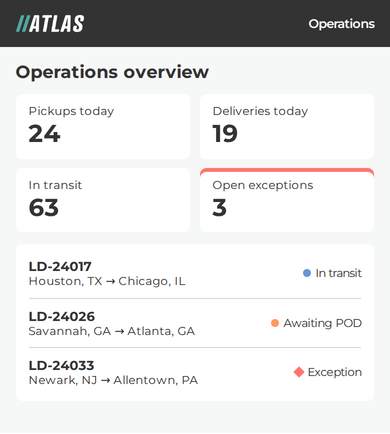
Operational context
You own the move, not every asset in it
A logistics provider plans the move, chooses carriers and equipment, and answers to the customer when something changes. The trucks, railcars, vessels and tanks usually belong to someone else.
Atlas gives your team one place to cost, dispatch and track each load, with carrier and customer portals for partner updates and visibility.
Who uses Atlas at a logistics provider
- Dispatchers and load planners
- Customer service and account teams
- Carrier management
- Billing, AP and AR
Key challenges
What gets in the way today
Too many carriers, too many formats
Each carrier and mode reports status its own way, so the team rebuilds the picture by hand.
Costs that drift from the plan
Rates, accessorials and carrier changes are hard to track against the cost model the move was sold on.
Customers who have to ask
Without a shared view, status updates depend on someone on your team sending them.
Relevant Atlas workflows
How Atlas supports your team
-
Enter and cost the order
Apply cost models by lane, mode and carrier.
-
Dispatch carriers and drivers
Dispatch Intelligence automates dispatch.
-
Track every leg
EDI, telematics and driver app updates in one timeline.
-
Keep customers informed
Customers see status and documents in their own portal.
-
Bill and settle
AP and AR processing connected to accounting.
Connected process
Where you sit in the move
You coordinate the move in Atlas. Other parties update the load through portals, Atlas Mobile and EDI.
- Shipper Places orders and follows shipments in a portal.
- Logistics provider You Costs, dispatches, tracks and bills the move.
- Tank operator Tank availability and washout requirements.
- Carriers Carrier portal, driver app and EDI updates.
- Consignee Delivery and proof of delivery.
In the product
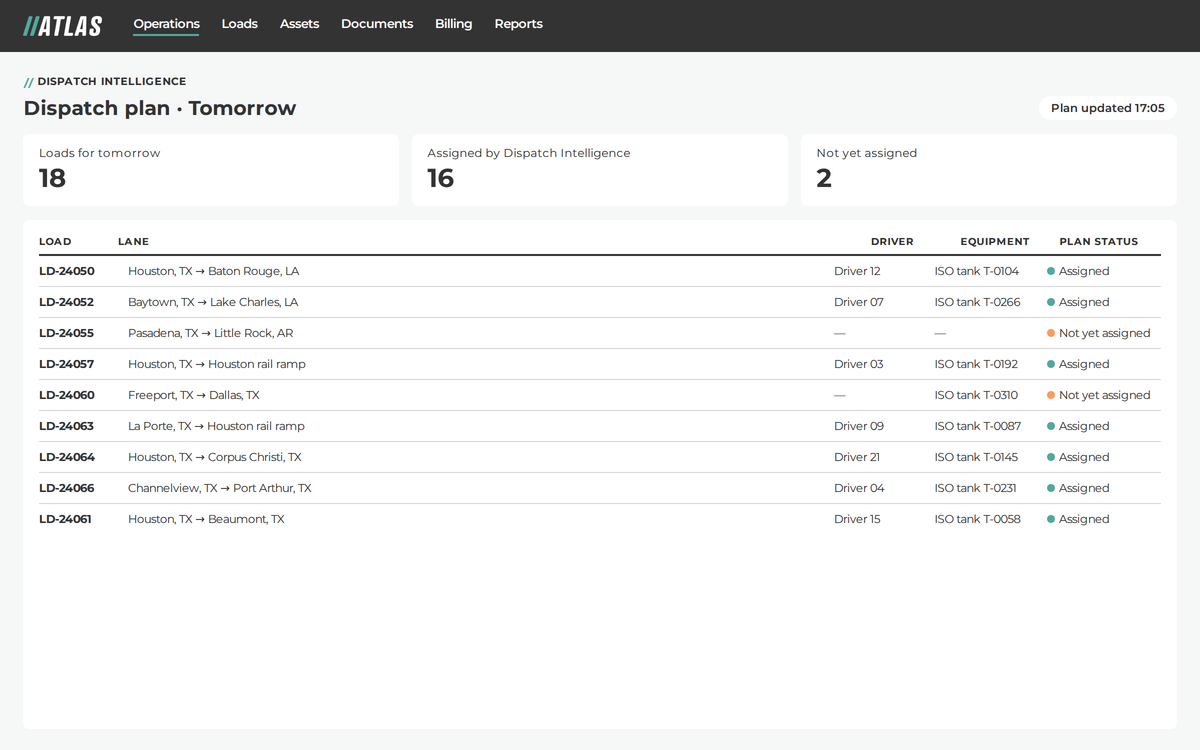
Tomorrow’s dispatch plan, built by Dispatch Intelligence
-
Automated dispatch
Dispatch Intelligence assigns drivers and equipment to the next day’s loads.
-
The whole plan in one view
Each load shows its lane, driver, equipment and status.
-
Part of the same platform
The plan sits alongside loads, tracking and documents in Atlas.
Relevant capabilities
Capabilities logistics providers use most
Order and cost management
- Order entry and web-based load management.
- Cost models by lane, mode and carrier.
Carrier and customer portals
- Carrier updates and paperwork captured as work happens.
- Customer portals with custom dashboards.
Security and operational trust
Connected to the partners you already use
Atlas connects to rail, ocean and drayage partners through EDI, and to telematics, accounting and reporting tools. Carriers and customers use web portals, and drivers use the Atlas Mobile app.
Security, IT and procurement questions go directly to our team.
See how Atlas fits your operation.
Tell us about your carriers, modes and customers. We will tailor the conversation to how your team plans and runs moves.
Prefer to start with a question?
Ask about carrier onboarding, integrations or security before you book a demo.