
Solutions · Intermodal companies
Keep every hand-off between modes in view
Atlas connects rail, drayage, ocean and terminal events for bulk liquid moves, so your team sees one timeline instead of five partner systems.

Operational context
The move is only as good as its hand-offs
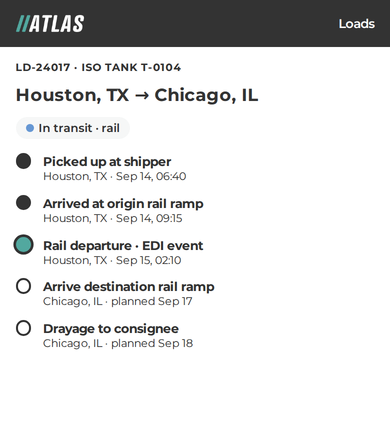
An intermodal tank move can run from a truck to a rail ramp, across the country by rail, through a port and onto a vessel, then back onto a chassis for final delivery. Every transfer produces an event, and every event comes from a different partner.
Atlas brings those EDI events, driver updates and documents into one record, so the whole move is visible from first pickup to proof of delivery.
Who uses Atlas at an intermodal company
- Intermodal and rail operations
- Drayage dispatch
- Customer service
- Billing and settlement
Key challenges
What gets in the way today
Events scattered across partners
Rail, ocean and drayage partners each send updates their own way, and nobody holds the full timeline.
Gaps at the ramp and the port
Tanks can sit between modes while the next move waits on information from the last one.
Paperwork from every leg
Each leg adds documents that have to be collected and matched before the move can be billed.
Relevant Atlas workflows
How Atlas supports your moves
-
Manage multi-mode moves
Truck, rail and ocean moves in one system.
-
Exchange EDI with partners
EDI with rail, ocean and drayage partners.
-
Dispatch drayage
Dispatch and GPS for drayage drivers using Atlas Mobile.
-
Capture documents per leg
Document Intelligence reads documents into the load.
-
Settle every leg
AP and AR processing for each carrier and customer.
Connected process
Where you sit in the move
You connect the modes. Atlas connects the data they produce.
- Shipper Tenders the load and follows it in a portal.
- Origin drayage Picks up the tank and delivers it to the ramp.
- Intermodal company You Coordinates rail, ocean and terminal legs.
- Rail and ocean carriers Report departures and arrivals by EDI.
- Destination drayage Delivers and captures proof of delivery.
In the product
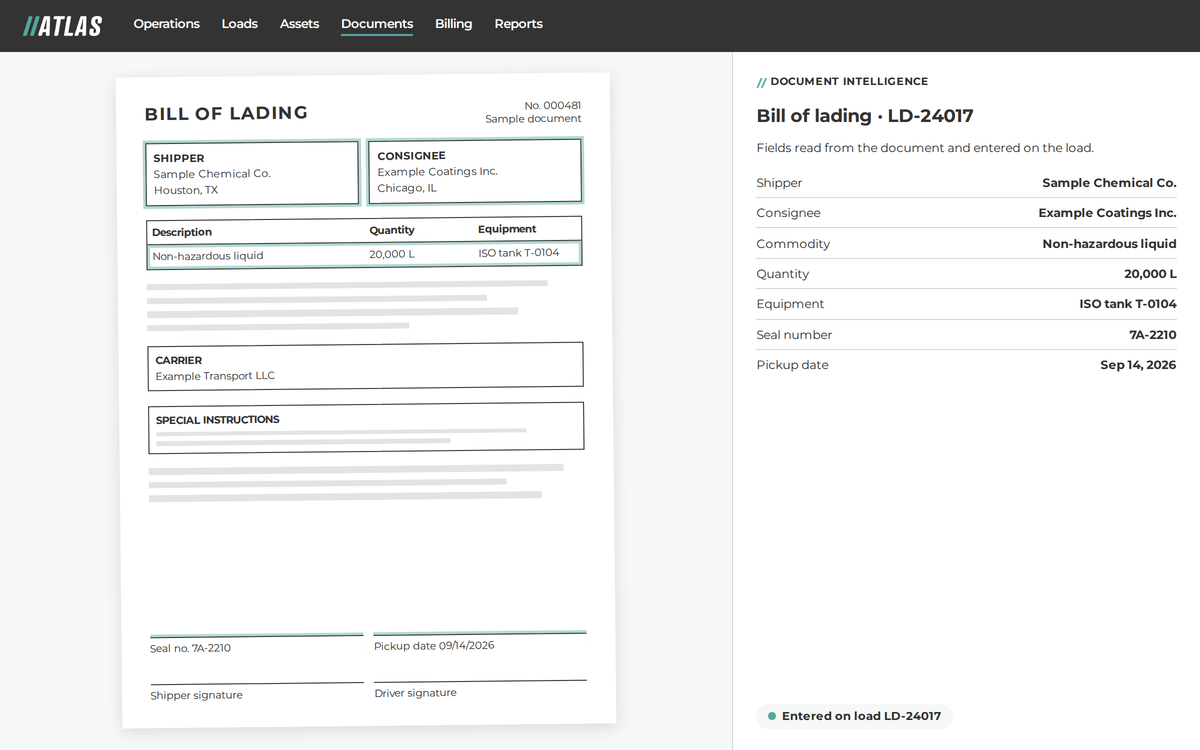
Documents from every leg, read in for you
-
Read automatically
Document Intelligence reads the fields from each document.
-
Entered in Atlas
The data is entered on the load.
-
Stored with the load
Integrated document imaging keeps the document image with the load.
Relevant capabilities
Capabilities intermodal companies use most
EDI and integrations
- EDI with rail, ocean and drayage partners.
- Telematics and railcar tracking data.
Track and trace
- Integrated tracking across modes.
- Geofences, notifications and alerts.
Security and operational trust
Built on the partner connections intermodal depends on
Atlas exchanges EDI with rail, ocean and drayage partners and runs in the cloud, so your partners connect through EDI, a portal or the Atlas Mobile app.
Security, IT and procurement questions go directly to our team.
See how Atlas fits your operation.
Tell us about your lanes, ramps and partners. We will tailor the conversation to the hand-offs your team manages.
Prefer to start with a question?
Ask about EDI partners, integrations or security before you book a demo.